
AI Is Not Reading Your Website First. It Is Reading Your Google Business Profile.
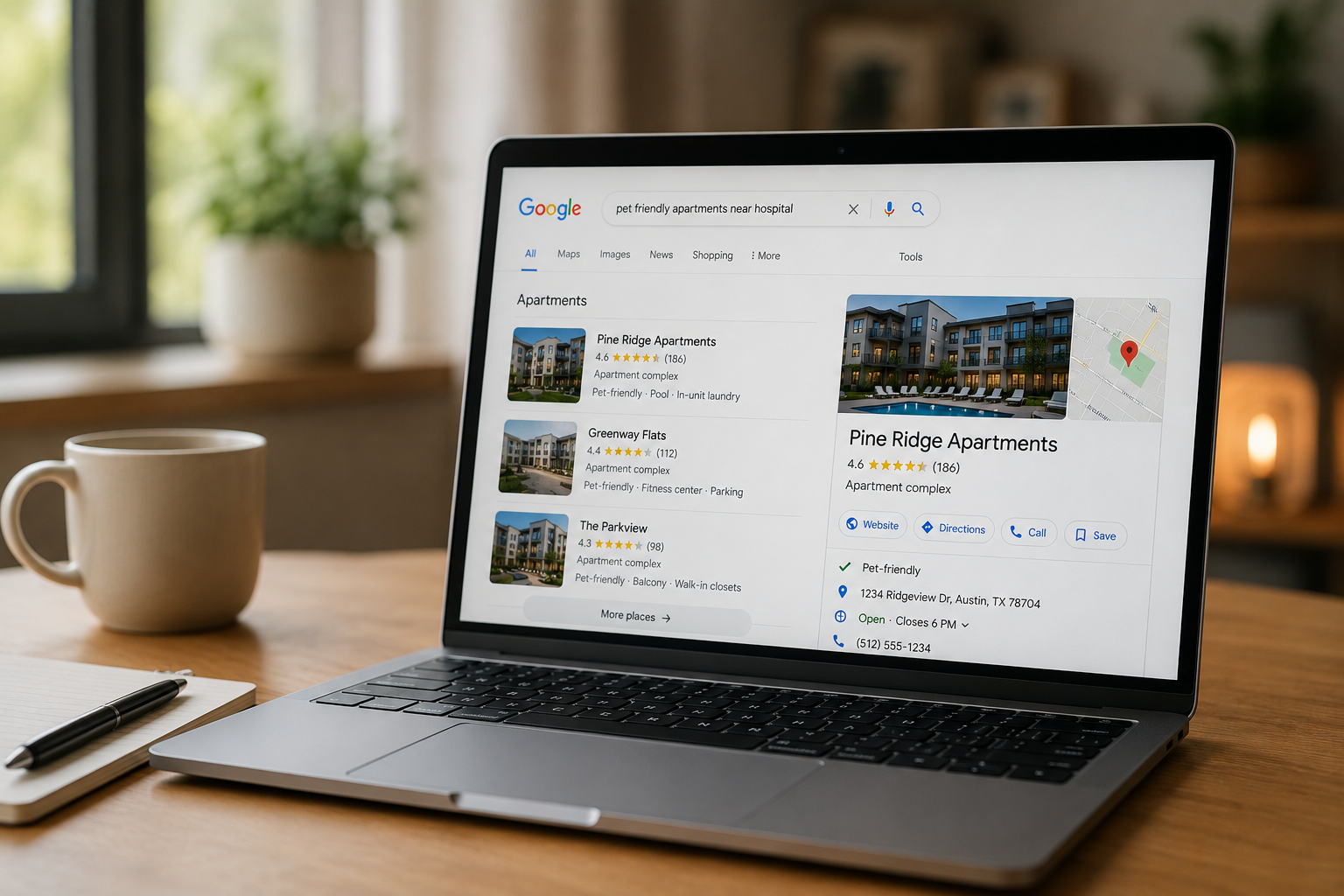
A renter's search for pet friendly apartments. The listing cards, ratings, and hours come from Google Business Profile data, not from the property websites.
Ask an AI assistant for the best pet friendly two bedroom near a specific hospital and it hands back a short list of named communities. Ratings, hours, a sentence about the neighborhood. Trace where that came from and it rarely started on the community website. It started on the Google Business Profile and the third party data feeding it.
That is a quiet reordering of what matters in multifamily marketing. For twenty years the website was the front door. In 2026 it is closer to the second stop.
The Profile Became the Primary Source
Google is explicit about where profile information comes from. According to Google Business Profile Help, listings are assembled from publicly available crawled web content, licensed third party data, contributions from users and business owners, and Google's own interactions with the place itself.
Read that list from the perspective of a system trying to answer a renter question. It is a pre-cleaned, constantly refreshed record of a physical place. Name, category, address, hours, phone, photos, reviews, review recency, questions and answers. No JavaScript to render, no leasing widget to work around, no marketing language to interpret. If you were building an answer engine, you would read that record first too.
Why This Matters More This Year Than Last
Two shifts landed at once. The first is behavioral. BrightLocal's Local Consumer Review Survey found that 45 percent of consumers now use ChatGPT and similar AI tools for local business recommendations, up from 6 percent the year before. AI platforms now sit third among recommendation sources, behind only Google and Facebook. Eighty two percent read AI generated review summaries, and 23 percent rely on those summaries alone.
The second is structural. HousingWire reported in August 2026 that roughly 68 percent of United States Google searches ended without a click in early 2026. When an AI Overview appears, that share rises to 83 percent. Inside Google's AI Mode it reaches 93 percent.
Renters are asking a machine, and the machine answers without sending them anywhere. What reaches the renter is whatever the machine already holds about your property. The profile is the largest part of that holding.
What Google Actually Says
There is less mystery here than the conference circuit suggests. On local ranking, Google Business Profile Help states that local results are "mainly based on relevance, distance, and prominence," and that "businesses with complete and accurate info are more likely to show up in local search results." It also says plainly that there is "no way to request or pay for a better local ranking on Google."
On AI, Google Search Central is equally direct. There are "no additional requirements to appear in AI Overviews or AI Mode, nor other special optimizations necessary," and no special schema you need to add. What Google does recommend in that same document is keeping Business Profile information up to date.
That is the instruction, sitting in public documentation. Accuracy and completeness, maintained. Not clever copy.
LocalLift Insight™
Across the apartment communities we monitor, the pattern is consistent enough to be useful.
The profiles that get named in AI answers are rarely the ones with the best photography. They are the ones where the facts agree everywhere. Category set as an apartment complex rather than a real estate agency. Hours that match the sign on the leasing office door. A phone number identical on the website, the ILS listings, and the answering service. Pet policy stated the same way in three places.
The failures are just as consistent, and most are administrative. A profile still owned by the prior management company. Duplicate listings left from a rebrand, splitting reviews between them. A primary category left at "apartment rental agency" since setup day. Photos from the pre-construction rendering package.
None of that is a content problem. It is a data hygiene problem with a new marketing consequence, because the record that used to sit quietly beside your website is the record being read aloud. Recency belongs in the same bucket. BrightLocal found 74 percent of consumers prioritize reviews from the last three months, and forty reviews from 2023 reads as a property nobody has discussed lately.
What to Do Next
1. Confirm ownership. Verify the profile belongs to the current management company, not a former vendor. Merge or remove duplicates first, because split reviews weaken both listings.
2. Fix the category and core fields. Apartment complex is usually the correct primary category. Confirm address, hours, phone, and website URL match every other listing you control.
3. Make policies explicit. Pet rules with weight and breed detail, parking, application fees, and utilities are among the questions renters ask AI most often. If the answer is not written somewhere readable, what gets delivered is a guess or a competitor.
4. Build a review recency loop. A steady trickle beats an annual burst. Reply to every review, since Google states that positive reviews and helpful replies help a business stand out.
5. Own the Q and A section. Seed the questions your leasing team answers by phone every day, and answer them in full sentences that name the property and the city. Those sentences are quotable. Fragments are not.
Frequently Asked Questions
Does a Google Business Profile affect whether AI recommends an apartment community?
Yes. AI assistants answering local questions rely heavily on structured place data, and the Google Business Profile is the most complete structured record most apartment communities have. A profile with the wrong category, stale hours, or a mismatched phone number sends conflicting signals, and those are easy to skip in favor of a competitor whose facts agree.
What is the most common Google Business Profile mistake at apartment communities?
Duplicate listings created during a rebrand or management change. Two profiles split the review history, photos, and authority, so neither looks definitive. Second is a profile still administered by a former marketing vendor, so nobody on the current team can correct anything.
Which primary category should an apartment community use?
Apartment complex is the correct primary category for a community that leases units directly. Apartment rental agency describes a brokerage, not a property, and communities left in that category compete for the wrong queries. Secondary categories help, but the primary one carries the most weight.
Do reviews matter for AI visibility, or only for renters?
Both. Reviews are renter-facing evidence and machine readable content at once. BrightLocal found 82 percent of consumers read AI generated review summaries and 23 percent read only the summary, so the summary now does the work the reviews used to do. Recency matters more than volume, with 74 percent prioritizing reviews from the last three months.
Is there special schema or an AI file needed to appear in AI Overviews?
No. Google's documentation states there are no additional requirements and no special schema.org markup needed to appear in AI Overviews or AI Mode, and that you do not need to create new machine readable or AI text files. Google does recommend keeping structured data accurate and Business Profile information current, which is where the effort belongs.
How quickly do Google Business Profile changes show up in AI answers?
There is no published timetable. Profile edits can appear in Google surfaces within days, but AI systems draw on cached and licensed data that refreshes on its own schedule, so treat the horizon as weeks rather than hours. Fix the record once, correctly, then maintain it.
The Takeaway
The website is not obsolete. It is no longer the first thing read. The Google Business Profile has become the record that answers the question before a renter reaches a site, and it rewards accuracy rather than persuasion. That is good news for operators, because accuracy is solvable with a known checklist.
The communities named in 2026 are not the ones with the best adjectives. They are the ones whose facts are correct, current, and consistent everywhere a machine might look.
If you want to see how your communities are represented across AI answers and local search today, The SocialDM and LocalLift work with multifamily teams on this layer. More on the approach is in our apartment SEO for multifamily communities overview, and more analysis like this is in Market Intelligence.