

Renters Are Asking AI About Your Property. The Problem Is the AI Cannot Read Your Website.
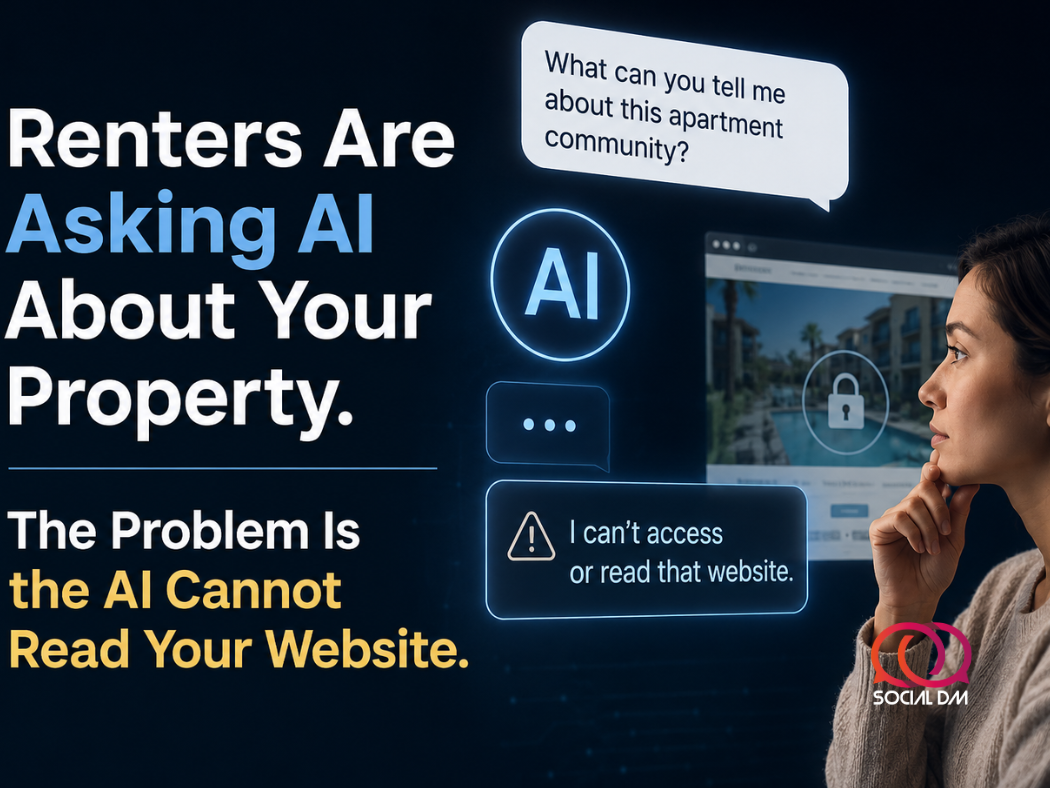
A renter opens ChatGPT and asks for the best pet friendly two bedroom near their new job. The AI answers with a short list of named communities. Yours is not on it.
Most operators assume that means they ranked low, or that a competitor outspent them. Often the real reason is stranger and more fixable than that. The AI never actually read your website. It could not.
This is the part of the AI search shift almost no one in multifamily is talking about. Being a good answer is not enough if the machine building the answer cannot see your content in the first place.
Here is what is actually happening, and what to do about it.
Renters Ask AI. The AI Reads Code, Not Design.
More than 80 percent of Americans now use AI somewhere in their housing research, according to a 2025 Realtor.com survey. They ask ChatGPT, Gemini, Claude, and Google's AI in plain language, and they trust the short list it gives back.
But the AI does not see your website the way a renter does. A renter sees photos, a leasing widget, a map, and a tour scheduler. The AI sees the raw code your page hands its crawler. If your real content is not in that code, the AI is working from a near-blank page.
So the question is no longer only whether your content is good. It is whether the AI can read it at all.
Most Leasing Websites Are Invisible to AI Crawlers
Here is the technical reality that decides who gets named. The crawlers that feed the major AI engines, including OpenAI's GPTBot, Anthropic's crawler, and Perplexity's, read the initial HTML of a page and do not run JavaScript.
That matters because a large share of apartment websites, especially those built on third-party leasing platforms, are client-side rendered. The page arrives nearly empty and then JavaScript paints in the floor plans, the pricing, the amenities, and the availability after the fact. A person's browser runs that JavaScript and sees a finished page. The AI crawler does not. It sees the empty shell that loaded first.
When that happens, your most important content, the specifics an AI needs to recommend you, is simply not there when the crawler looks. The community could have the best pricing and the clearest story in the market, and the AI would still pass it over, because to the AI the page said almost nothing.
Google Renders JavaScript. The AI Crawlers Mostly Do Not.
This is where operators get a false sense of safety. Googlebot can render JavaScript. It uses a second pass with a headless browser to fill in content that loads late, so a JavaScript-heavy site can still rank in traditional Google results.
That history is exactly what makes the blind spot dangerous. Teams assume that because their site shows up in Google, it must be readable everywhere. It is not. Google's ability to render JavaScript is the exception. The AI crawlers reshaping apartment search are the rule, and most of them take the page as it first loads and move on.
So a property can look healthy in old-school search and be effectively missing from the AI answers that a growing share of renters now trust.
The Fix Is a Layer the AI Can Actually Read
The answer is not to rebuild a leasing site that already works for renters. It is to make sure there is a version of your community's facts that loads in plain, server-rendered HTML, structured so an AI can read it on the first pass, with no JavaScript required.
That means content delivered as text the crawler sees immediately, the way your neighborhood, your floor plans, your pricing context, and your real answers to renter questions are written out and marked up so machines can quote them. It is the difference between hoping the AI guesses right about you and handing it the exact, structured answer.
This is the layer most communities are missing, and it is the layer the LocalLift Visibility System was built to create and maintain alongside the site you already have. You keep your existing leasing experience for renters. You add the readable, quotable surface the AI needs to name you.
LocalLift Insight™
Across the properties we track, the communities that disappear from AI answers are rarely the ones with the worst content. They are the ones whose best content only exists after JavaScript runs.
When we put the same facts into a clean, server-rendered, structured layer the crawlers can read on the first pass, the community stops being invisible to the systems building the renter shortlist. The content did not change. Its readability did. That gap between what your renters see and what the AI sees is exactly what the LocalLift™ Visibility System is built to close.
Your AI-Readability Checklist for This Quarter
Test what the AI sees. Ask a real renter question across ChatGPT, Gemini, and Google AI for your market, and note whether your community is named at all. Absence is the signal.
Check whether your key content loads without JavaScript. If your floor plans, pricing context, and amenities only appear after the page finishes loading, assume the AI crawlers are not seeing them.
Make your facts available as plain, server-rendered text. The crawler should find your community's specifics in the HTML it receives first, not in scripts it never runs.
Write your answers in full questions and direct responses, then mark them up so machines can lift them cleanly.
Keep the facts consistent everywhere. The readable layer, your Google Business Profile, and your reviews should tell the same story, because agreement is what earns the recommendation.
Then keep it current. A readable layer that goes stale is a readable wrong answer.
FAQ
Why does my apartment website not show up in AI search results?
Often it is because the AI crawler cannot read your content. The crawlers behind tools like ChatGPT, Claude, and Perplexity read a page's initial HTML and do not run JavaScript. If your leasing site loads its floor plans, pricing, and amenities through JavaScript after the page arrives, those details are invisible to the AI, so it cannot recommend a community it effectively never read.
Do AI crawlers read JavaScript?
Most do not. The major AI crawlers, including OpenAI's GPTBot and Perplexity's crawler, read the initial HTML of a page and generally do not execute JavaScript. Content that only appears after JavaScript runs is missing from what those crawlers ingest, which is why client-side rendered websites are often invisible to AI search.
My site ranks on Google. Why would AI not see it?
Google is the exception. Googlebot can render JavaScript with a second rendering pass, so a JavaScript-heavy site can still rank in traditional Google results. The AI crawlers feeding answer engines generally do not render JavaScript, so a site that ranks fine on Google can still be missing from AI-generated recommendations.
What is server-side rendering and why does it matter for AI visibility?
Server-side rendering means the web server sends a fully formed HTML page with the real content already in it, rather than an empty shell that JavaScript fills in later. It matters because AI crawlers read that first HTML response. When your community's facts are in server-rendered HTML, the AI can read and quote them without running any JavaScript.
How do I find out if AI can read my apartment website?
Start by asking the AI tools the questions your renters ask and seeing whether you are named. Then check whether your core content appears in the page's raw HTML before any JavaScript runs. If your pricing, floor plans, and amenities only show up after the page loads, the AI crawlers are likely missing them, and a readable layer is needed.
Do I need to rebuild my leasing website to be visible in AI search?
No. You do not have to replace a leasing site that works for renters. The practical fix is to add a server-rendered, structured layer of your community's facts that AI crawlers can read on the first pass, alongside your existing site. That is the approach the LocalLift Visibility System uses to make a community readable to AI without disrupting the renter experience.
Your Renters Can See Your Site. Make Sure the AI Can Too.
The renter shortlist is being assembled inside an AI answer, and a community that the AI cannot read is a community that does not exist to it, no matter how good the website looks to people.
This is the quiet reason many strong properties are missing from AI recommendations in 2026. The good news is that it is a solvable, technical gap, not a verdict on your community.
If you want to see what the AI actually reads when it looks at your property, that is exactly what the LocalLift Visibility System was built to show you.