

Multifamily Doesn't Have a Data Problem. It Has a Discovery Problem.
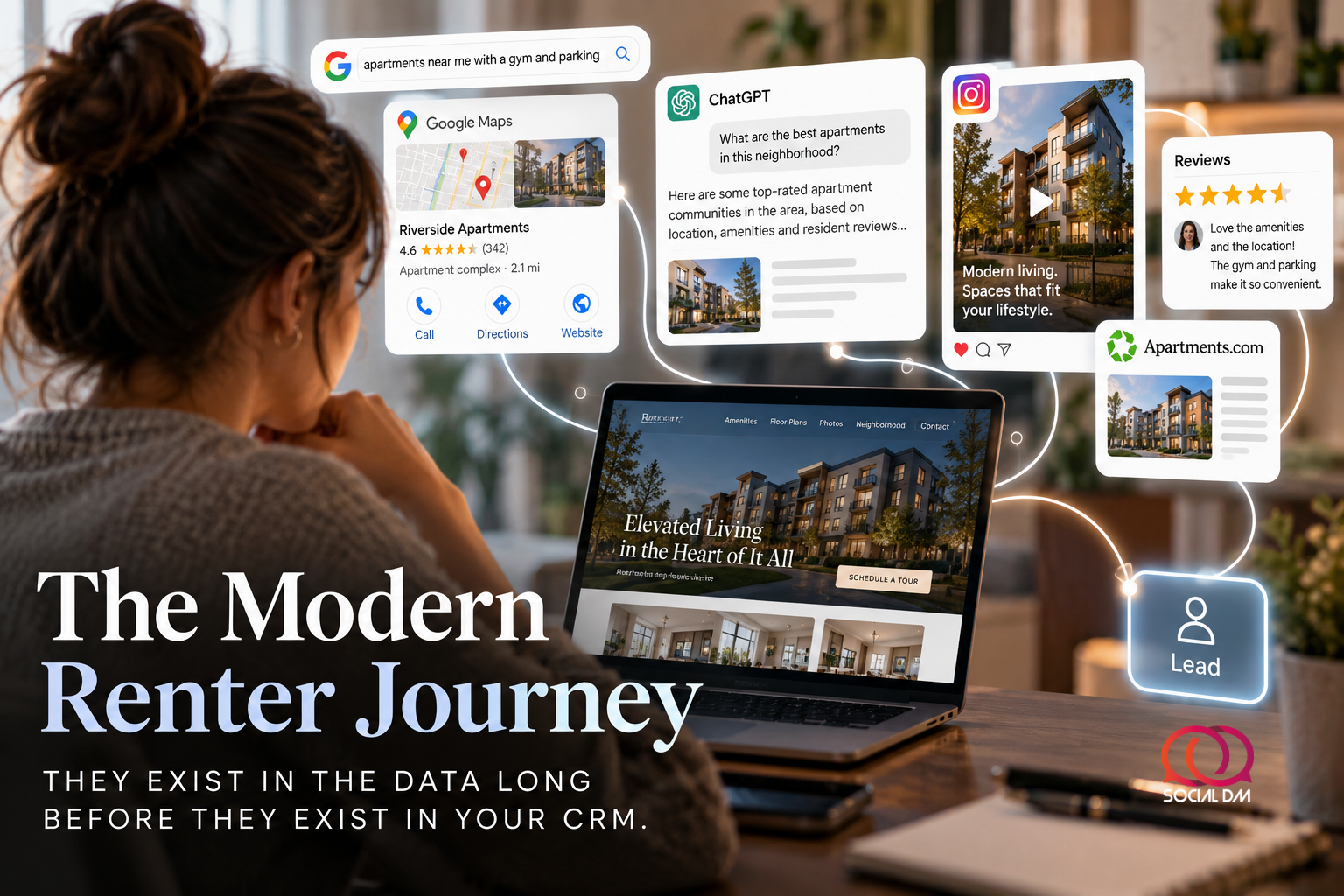
Renter journey from Google Maps and AI search to apartment leasing, illustrating multifamily discovery data before a lead reaches the CRM
Most property teams are not short on reports.
Occupancy. Leads. Applications. Leases. Concessions. Traffic. Cost per lead.
All of it matters. But most of it describes the same moment in the renter journey: the point after someone has already raised their hand. It tells you what happened once a renter entered the leasing funnel.
The bigger question is what happened before that.
The renter exists long before the lead does
Before a prospect fills out a contact form or calls the leasing office, they have usually done a lot of homework on their own.
They searched Google for apartments in the neighborhood. They found a handful of communities on Google Maps. They read reviews, and they read how management replied to them. They compared two or three properties side by side. They watched short videos on Instagram or TikTok. They browsed an ILS (internet listing service). More and more often, they asked ChatGPT, Gemini or Google's AI Mode which communities fit what they want. Then they searched for your property by name.
That renter exists in the data well before they exist in your CRM.
This is the part of multifamily reporting that deserves far more attention. Not another 30 page dashboard. What teams need is a clear view of where future renters are searching, what they are asking, whether the property is showing up, how it is being described, and where it is losing visibility to nearby competitors.
Why it matters now
The early part of the search has moved to places most leasing reports never look.
Google is explicit that local results are driven mainly by relevance, distance and prominence, and that more reviews and positive ratings can help a business rank locally. Its own guidance on how local ranking works also notes that complete, accurate business information makes a profile more likely to show up in local results. None of that shows up in a traffic report until traffic has already slipped.
AI search adds another layer. Google describes how AI Overviews and AI Mode can run several related searches behind the scenes to build a single answer, then show supporting links. Its documentation on AI features and your website recommends checking that your Business Profile information is up to date. When a renter asks an AI assistant for the best pet friendly apartments near their office, the assistant assembles that answer from whatever trusted information it can find. If your community is thinly described across the web, it is easy to leave out.
Operational data vs. discovery data
It helps to separate reporting into two sides.
Operational data tells you how the property is performing. Occupancy, leasing velocity, conversion rates, renewals, concessions.
Discovery data helps explain why. Local search visibility, Google Maps position across the surrounding area, review volume and sentiment against nearby communities, the questions renters are actually searching, and whether AI platforms mention the property when someone asks.
When the two start working together, reporting stops being a scoreboard and becomes something a team can act on.
Instead of a report that simply says traffic is down, you can start asking better questions:
Are fewer renters finding us in local search?
Has our Maps visibility changed in the neighborhoods we lease from?
Are competitors gaining ground in reviews?
Are renters searching for amenities or lifestyle features we are not talking about?
Are AI platforms finding enough trusted information to understand and recommend the property?
LocalLift™ Insight
Across the apartment communities we monitor through LocalLift™, a familiar pattern shows up. When a property reports a dip in traffic, the cause often shows up in discovery data first.
Sometimes a nearby lease up starts collecting reviews faster and moves ahead in the Maps results for the searches that matter most. Sometimes a Google Business Profile has gone weeks without fresh photos or posts while competitors stayed active. Sometimes renters are searching for something specific, like dog parks, EV charging or work from home space, and the property website does not mention it yet, so neither Google nor AI assistants connect the community to that need.
None of these show up in a CRM. All of them can be measured. And many of them can be addressed quickly once someone is watching.
What to do next
You do not need a new platform to start. You need a short list of signals checked on a regular rhythm.
Search your own property the way a renter would. Try category searches like "apartments near" a local employer or landmark, not just your property name.
Check Maps visibility beyond your front door. Where you appear one mile away matters more than where you appear in your own parking lot.
Benchmark reviews against your real competitors. Look at volume, recency, rating and how consistently replies go out.
Ask the AI assistants directly. Ask ChatGPT, Gemini and Perplexity for recommendations in your submarket and note whether you are mentioned and how you are described.
Close the content gaps. If renters are searching for a feature you offer, make sure your website, your Business Profile and your social content say so clearly. Our guide to apartment SEO for multifamily communities covers where to start.
Frequently asked questions
What is discovery data in multifamily marketing?
Discovery data describes how renters find and evaluate an apartment community before they become a lead. It includes local search visibility, Google Maps position, review performance against competitors, renter search questions, and whether AI platforms mention the property.
How is discovery data different from leasing reports?
Leasing reports measure what happens after a renter contacts the property, such as tours, applications and leases. Discovery data measures what happens before that contact, which is often where changes in traffic actually begin.
Why would apartment traffic drop when nothing changed at the property?
The property may not have changed, but the search landscape around it can. A competitor may have gained reviews, Maps positions may have shifted, or renters may be searching for features the property is not describing online. Discovery data helps identify which of those happened.
Do AI assistants like ChatGPT recommend specific apartment communities?
Yes. Many renters now ask AI assistants for apartment recommendations, and those tools build answers from information they can find and trust across the web. Communities with consistent, detailed and well reviewed online information are easier for them to understand and recommend.
How often should a property team review discovery data?
Weekly is a practical rhythm for most communities, and especially for lease ups. Search visibility and reviews can shift quickly, and a weekly check catches changes before they show up as lower traffic or slower leasing.
The takeaway
Multifamily does not need more data. It needs the right data, read in the right order. Operational numbers tell you what happened. Discovery signals tell you why, and often tell you first.
The future of multifamily measurement will not belong to whoever has the biggest dashboard. It will belong to the teams that can turn the right signals into the next action.
If you want to see what renters see before they ever reach your leasing office, start a conversation with The SocialDM. You can also explore more of our thinking in Research & Insights and the Market Intelligence blog, or learn more at LocalLift™.